NEWSLETTER Issue 4
24 October 2025

24 October 2025
The best science journalists are defined by curiosity and open-mindedness, qualities exemplified by our keynote speakers: advocate Cormac Cullinan, Dr David Obura, and Prof Linda-Gail Bekker.
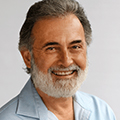 On 2 December, South African environmental attorney Cormac Cullinan will discuss our evolving role on the planet as humans and journalists. He has advised governments in over 30 countries, contributed to environmental treaties and laws, and authored Wild Law: A Manifesto for Earth Justice (2002), a seminal work in the Rights of Nature movement. Cullinan helped draft the Universal Declaration of the Rights of Mother Earth and is active in the Antarctic and Table Mountain Rights initiatives. He has received multiple honours, including the Ecologic Lifetime Achievement Award (2018) and South African Environmentalist of the Year (2012).
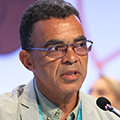 On 3 December, Kenyan marine biologist Dr David Obura will examine the role of science journalists in translating research into public understanding and policy. He highlights the challenge of declining trust in science and encourages journalists to use data to shape narratives and decisions. Dr Obura directs CORDIO East Africa, chairs IPBES, and is a member of the Earth Commission. His awards include Kenya’s Moran of the Burning Spear (2021) and the Coral Reef Conservation Award (2022).
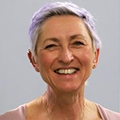 On 4 December, Prof Linda-Gail Bekker, Chief Executive of the Desmond Tutu Health Foundation and Director of the Desmond Tutu HIV Centre, will share insights on public health, policy, and equity. An infectious disease specialist and former president of the International AIDS Society, she received a standing ovation at AIDS 2024 for presenting the PURPOSE 1 Trial results, showing lenacapavir prevents HIV transmission. Her work spans antiretroviral roll-out, TB integration, HIV prevention for women, youth, and MSM, and health equity, reflecting WCSJ 2025’s focus on social justice.
Avoid disappointment and register now.
To help plan your stay, explore the following resources on our website:
Kenya Airways is offering discounted flights to WCSJ 2025 delegates. Full details are available on our Transport page, which also provides useful information on travel options from OR Tambo International Airport in Johannesburg to Pretoria, including the Gautrain.
Some accommodation options near the CSIR International Convention Centre are offering special rates for attendees.
Wondering what the difference is between Pretoria and Tshwane?
Pretoria is the administrative capital of South Africa, located within the larger City of Tshwane metropolitan area.
The names are often used interchangeably by locals.




While sessions addressing our conference theme, “Science journalism and social justice: journalism that builds understanding and resilience”, appear throughout the programme, Day 2 of WCSJ 2025 (2 December 2025) will focus particularly on this theme.
A highlight of the day is a roundtable debate, moderated by Latoya Abulu (Canada) of Mongabay, which will bring together Indigenous leaders, conservation experts, and journalists to examine the responsibilities of science journalists in covering Indigenous-led conservation. Key topics will include navigating sympathy and solidarity with communities, maintaining journalistic objectivity, and upholding free, prior, and informed consent. This session is produced by John Cannon, a features writer at Mongabay (USA), and Véronique Morin (Canada), a former president of WFSJ. Speakers will come from Greenland, the Democratic Republic of the Congo, and the United States.
Alexandra Nistoroiu of Snoop.ro and the Balkan Network of Science Journalists will lead a session on the ethical challenges of reporting on mental health. Speakers include Myriam Vidal Valero of the Mexican Network of Science Journalists, Chibuike Alagboso of Nigeria Health Watch, and journalist and filmmaker Ania Gruszczyńska, based in the UK.
Additional sessions will explore topics such as covering the effects of social and environmental health challenges on children, the impact of industry on health and ecosystems, reporting on vulnerable communities affected by climate change, and the role of radio as a lifeline in risk communication.
The day will close with an open session, giving journalists the opportunity to share and reflect on how their work has contributed to social justice and made a difference in the lives of others.
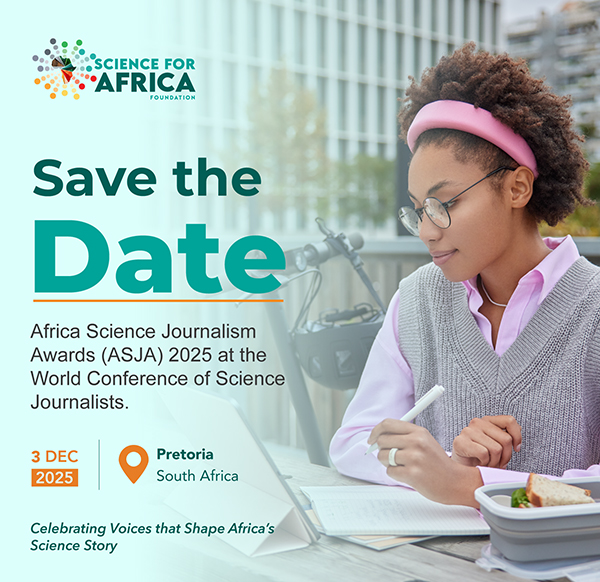
A breakfast event at WCSJ 2025 will see the announcement of the 2nd Africa Science Journalism Awards (ASJA). ASJA is organised by the Science for Africa Foundation (SFA Foundation) and supported by the Gates Foundation. It honours African journalists who excel in reporting on issues related to health, climate change, the environment and agriculture, all thematic focus areas of the SFA Foundation.
The awards ceremony will take place on the morning of 3 December 2025 and is by invitation only. If you are attending WCSJ 2025 and wish to join the event, email Natasha Kiiru or ASJA@scienceforafrica.foundation.
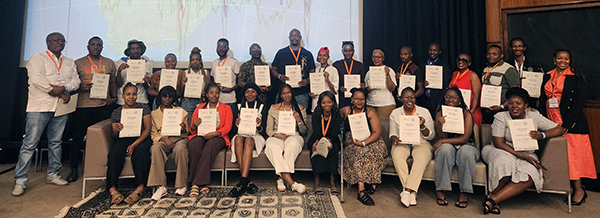
On 1 December, journalists from the 15 member countries of the Southern African Development Community (SADC) will come together for the annual SADC Science Journalism Training Workshop, hosted by the SADC Secretariat in collaboration with South Africa’s Department of Science, Technology and Innovation (DSTI) and partners.
Since its launch in 2022, the workshop has fostered a network of over 100 SADC journalists, addressing topics such as reporting on natural disasters and extreme weather events, hosting radio talk shows on science in local languages, and sourcing regional expertise. The 2025 edition will continue to focus on capacity building, strengthening regional collaborations, and empowering the region’s collective voice to drive change on issues such as climate, science, technology, and health.
The workshop is open to WCSJ attendees who wish to enhance science journalism skills and foster collaboration across the SADC region.
Please note: Registration for a day pass to attend the Workshop Day only, including the SADC workshop, on 1 December 2025 is also available. See our workshop programme for details.
Just 50 km from OR Tambo International Airport and linked by the Gautrain, Pretoria is a hub of culture, diplomacy, science, and nature.
Explore grand architecture, museums, monuments, bustling markets, and vibrant townships, alongside fine dining, street cafés, and modern shopping centres. Tshwane hosts over 135 embassies and international missions, making it a global diplomatic centre. The Union Buildings, home to the President, also welcome visitors from around the world.
A hub for education and science, the city boasts four universities and seven national science councils, and is recognised as Africa’s Science Diplomacy Capital.
Nature lovers will enjoy a Big Five game reserve, the only one within a metropolitan area worldwide, along with other reserves, wetlands, and green belts that are ideal for wildlife and birdwatching.
Learn more at Tshwane Tourism and What To Do in Tshwane, or explore its history on Wikipedia – Pretoria and the Pretoria Bucket List.